Spot the Value
Designed an interactive training and job aid to help booksellers identify books with potential online resale value and make more consistent routing decisions.
Role: Instructional Designer
Audience: New and Experienced Booksellers
Deliverable: Interactive eLearning Course and Performance Support Job Aid
Tools: Articulate Storyline, Vyond, PowerPoint, Canva
Learning Objectives
By the end of this training, learners will be able to:
-
Evaluate a stack of books to identify titles with potential online resale value.
-
Analyze book scan data to determine the appropriate sales route for each title.
-
Apply the Spot, Stack, Scan, and Route process when evaluating books during a buy.
Explore the Module
Open the interactive course to practice identifying books with potential online resale value, interpreting scan results, and making routing decisions.
View the Job Aid
A quick-reference guide designed for use at the buy counter to reinforce the Spot-Stack-Scan-Route process.

Overview
A used bookstore was missing opportunities for online sales because booksellers did not have a consistent process for identifying books with potential online resale value or interpreting book scan data. I created an interactive training that showed the real-world consequences of routing decisions, gave learners practice with a realistic buy scenario, and included a job aid to support the process after the training.
I served as the instructional designer and managed the project from analysis through development. I conducted the needs assessment, created the visual design, wrote and developed the Vyond video, built the Storyline course and activities, and designed the companion job aid.
The Challenge
Booksellers at the buy counter were sometimes overlooking books with potential online resale value and routing them to the sales floor instead. Because employees did not always know which value indicators to look for or how to interpret scan information, decisions could vary from one bookseller to another. In a fast-paced buy-counter environment, the lack of a clear, repeatable process led to missed online sales opportunities and less consistent routing decisions.
Analysis
During the analysis phase, it became clear that the issue was not a lack of effort from booksellers. Employees did not always know which characteristics could indicate potential online resale value or how to interpret scan information consistently. Without a clear process, routing decisions could vary from one bookseller to another.
Because the performance gap involved both knowledge and decision-making, an interactive learning experience was selected. This approach gave learners a realistic opportunity to identify value indicators, interpret scan results, and practice routing books appropriately. A companion job aid was also created to reinforce the Spot–Stack–Scan–Routeprocess during real buys.
Solution Strategy
I designed a two-part solution that included an interactive training and a companion job aid. The training gave booksellers a low-pressure environment to practice identifying potentially valuable books, interpreting scan information, and making routing decisions.
The job aid supported employees after the training by providing a quick reference they could use while working at the buy counter. Together, the two resources addressed both the need for realistic practice and the need for support in a fast-paced work environment.
Key Design Decisions
A Memorable Four-Step Process
I organized the procedure into four short steps: Spot, Stack, Scan, and Route. The name is easy to remember and fits naturally into the workflow buyers already follow. Creating a repeatable routine helps keep the process at the front of employees’ minds during each buy and supports more consistent decisions across buyers with different levels of experience.
Authentic Book Examples
I used real book covers and realistic examples rather than fictional titles. The activity included books from different store sections because buyers evaluate books for the entire store, not just one department. Using familiar titles and a realistic mix made the practice feel closer to an actual buy-counter experience.
Manageable, Low-Pressure Practice
I limited the activity to ten books so learners could focus on each title without feeling overwhelmed by the volume they might encounter during a real buy. Learners were also allowed to continue after making mistakes instead of being required to earn a perfect score or restart the activity. This gave them space to review the correct answers and reflect on the reasoning without becoming frustrated.
Explanatory Feedback
The feedback did more than identify whether an answer was correct or incorrect. It explained which characteristics could indicate potential value and how to interpret the information shown in the scan results. This was important because the goal was not simply to recognize certain book categories, but to understand how the available information supports a routing decision.
Business Context Through Video
The Vyond video introduced the consequences of routing a book incorrectly before learners began the interactive practice. It showed how a potentially valuable book could remain unsold, be marked down, and eventually be donated if it did not reach the right customer. It also showed how routing the same book to online sales could connect it with a customer specifically searching for it and produce a stronger return.
Balanced Routing Decisions
The job aid included reminders about both online-value indicators and books that should remain in the physical store. Although online sales create additional opportunities, the brick-and-mortar store still depends on popular titles, bestsellers, and books customers need for school projects. The goal was to help buyers choose the appropriate sales channel rather than automatically routing every promising book online.
Point-of-Need Support
The job aid was designed to be placed at the buy counter, where employees could glance at it while reviewing books and calculating an offer. Keeping it within view allowed buyers to use the reference without stepping away from the customer or interrupting the normal flow of the buy process.
Final Solution
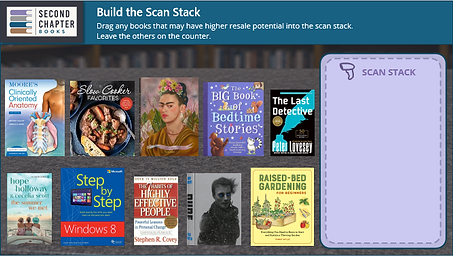
The completed solution included an interactive Storyline course with an embedded Vyond video. The video showed two possible outcomes for the same book: being placed on the store shelf, marked down, and potentially donated, or being routed to online sales and found by a customer specifically searching for it. Learners then practiced the full Spot–Stack–Scan–Route process by identifying books for a scan stack, reviewing scan results, and deciding whether each book should be routed to online sales review, the store shelf, or a no-buy/donation stack. The course concluded with a review of the four-step procedure.
A companion job aid provided a quick, at-a-glance reference for use at the buy counter. It reinforced the process, highlighted common green flags for potential online resale value, and reminded employees how to interpret scan data when making routing decisions. Together, the course and job aid prepared employees to identify potential value indicators, interpret scan information, and make more informed decisions about where each book should be routed.
Project Screens
Selected screens from the module show learners practicing the Spot–Stack–Scan–Route process. Learners first identify books with potential online resale value, then review scan data such as price, availability, edition, and condition before making a routing decision.

Performance Support Job Aid
The companion job aid provides an at-a-glance reference for use at the buy counter. It reinforces the
Spot–Stack–Scan–Route process, highlights common indicators of potential online resale value, and helps booksellers interpret scan information while making routing decisions.
Reflection
One of the most interesting parts of this project was seeing how the Vyond video could support the reasoning behind the training. By showing two different outcomes for the same book, the video made the consequences of the routing decision easier to understand. It also showed that making the appropriate decision could benefit both the store and the customer. The most challenging part was selecting the books for the Build a Scan Stack activity. I wanted the group to feel like a realistic buy while also including enough variety to expose learners to several different green flags for potential online resale value.
I am especially proud of the Spot–Stack–Scan–Route process because it is short, memorable, and fits naturally into a workflow that already exists. I believe that could make the process easier to adopt and reduce resistance to change. In a real implementation, I would gather feedback from experienced booksellers and store managers to confirm that the examples reflect the books they would notice during an actual buy. I would also ask for input on additional categories or indicators that could suggest potential value for online sales and track whether more books were being routed appropriately and contributing to increased online sales.