Technical Support for Non-Technical Customers
Designed a scenario-based eLearning module to help technical support representatives communicate troubleshooting steps clearly, reduce customer confusion, and support non-technical customers with empathy and confidence.
Role: Instructional Designer
Audience: Technical Support Representatives
Deliverable: Scenario-Based eLearning Module
Tools: Articulate Storyline, Canva, Mind Meister, AI Image Generation
Learning Objectives
By the end of the training, learners will be able to:
-
Recognize verbal and behavioral signs that indicate a customer is confused.
-
Translate technical information into clear, jargon-free language using examples, analogies, and step-by-step explanations.
-
Apply comprehension-checking techniques before advancing to the next troubleshooting step.
-
Respond to customer frustration with empathy, professionalism, and collaborative problem-solving.
Explore the Module
Open the interactive Storyline module to experience a scenario-based customer support call.
Overview
If this module were implemented with technical support representatives, I would evaluate its effectiveness by looking for changes in both customer experience and representative performance. Key measures would include shorter call times, fewer repeat callbacks for the same issue, higher customer satisfaction scores, and increased representative confidence when supporting customers with little or no technical background.
I would also gather feedback from representatives and supervisors to determine whether the communication strategies felt practical during real calls. If customers continued to experience confusion or call back for additional support, I would review those patterns and revise the module by adding additional decision points, clarifying feedback, or expanding examples of how to explain technical steps in plain language.
The Challenge
Technical support representatives were struggling to explain troubleshooting strategies to customers with little or no technical background. Although the representatives had strong technical knowledge and effective troubleshooting skills, guiding customers through unfamiliar technical steps was difficult.
Because customers lacked foundational knowledge, support conversations often became frustrating, took longer than necessary, and sometimes resulted in customers needing to call back for additional assistance. The challenge was not a lack of technical expertise, but a communication gap between what representatives knew and what customers could easily understand and apply.
Analysis
During analysis, I created an action map to identify the specific behaviors support representatives needed to perform during customer troubleshooting calls. The analysis showed that the issue was not a lack of technical knowledge. Representatives understood the troubleshooting process, but they needed stronger communication strategies for guiding customers who did not have the same technical background.
The action map identified four key behaviors: recognizing when a customer is confused, translating technical language into plain language, checking for understanding before moving on, and responding appropriately to customer frustration. These behaviors became the foundation for the learning experience and helped ensure the module focused on practical communication skills rather than general customer service advice.

Solution Strategy
Because the performance gap involved communication decisions during live customer interactions, I designed a scenario-based eLearning module built around a single customer support call. As the call progressed, learners encountered multiple decision points where they had to analyze the customer’s response and decide how the representative should respond next.
This approach was important because a response that moves the conversation forward with a technically knowledgeable customer may not be effective for a customer who is confused, hesitant, or frustrated. If representatives miss signs of misunderstanding or fail to check for understanding, the call may take longer, the customer may become more frustrated, or the customer may need to call back for additional support. The scenario gave learners a safe way to practice recognizing these moments and choosing communication strategies that support customer understanding.
Key Design Decisions
Designed One Continuous Customer Call
I designed the module around one continuous customer support call rather than separate unrelated scenarios. This allowed learners to see how small communication choices build on each other throughout the conversation. As the call progressed, different signs of confusion, misunderstanding, or frustration appeared, requiring the representative to pause, recognize the customer’s needs, and adjust their response.
This structure helped learners practice responding to the customer in context instead of treating each decision as an isolated moment. By addressing confusion or frustration each time it appeared, representatives could help the customer feel heard, supported, and more confident following the troubleshooting process.
Used Realistic Response Options
The answer choices were designed to feel like realistic responses a technical support representative might actually use during a call. Some responses could move the conversation forward with a customer who has more technical knowledge, but they would not fully support a customer who is confused, hesitant, or frustrated.
This encouraged learners to think beyond whether a response was technically correct and consider whether it matched the customer’s current level of understanding. By comparing realistic options, learners practiced choosing responses that reduced confusion, supported customer confidence, and kept the call moving forward effectively.
Provided Reflective Feedback
After each decision point, learners received feedback explaining why a response was or was not helpful to the customer. The feedback focused on how the representative’s choice affected the customer’s understanding, confidence, and ability to continue with the troubleshooting process.
In some cases, the feedback also prompted learners to think about how they could move the call forward, such as by asking what could be done to reduce confusion or better support the customer. This helped learners reflect on the purpose behind each communication choice rather than simply memorizing the correct response.
Connected Communication Choices to Customer Outcomes
The final slides were designed to show the impact of effective communication on the customer experience. After the representative uses plain language, checks for understanding, and responds professionally, the customer successfully resolves the issue and leaves the interaction feeling supported. The customer satisfaction screen reinforces that positive, empathetic communication can lead to a smoother resolution and positive feedback for the representative.
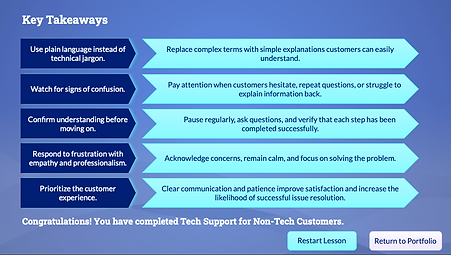
The module also concludes with key takeaways that summarize specific actions representatives can recognize and incorporate into future calls. These takeaways reinforce the behaviors identified in the action map, including using plain language, watching for signs of confusion, confirming understanding, responding to frustration with empathy, and prioritizing the customer experience.
Final Solution
I created a scenario-based eLearning module in Articulate Storyline that follows a single customer support call from start to finish. Throughout the call, learners make decisions based on the customer’s responses and receive feedback explaining how their choices affect the customer’s understanding, frustration level, and ability to continue troubleshooting.
Once the call is complete, learners see a results screen that explains the impact of the interaction on the customer experience, followed by a customer satisfaction survey that reinforces the outcome of clear, patient, and empathetic support. The module concludes with key takeaways that outline specific strategies representatives can use to recognize when a customer needs additional support, reduce confusion, respond to frustration, and guide customers through technical troubleshooting more effectively.
Project Screens
Selected screens from the module show scenario-based practice, checks for understanding, and key takeaways that reinforce effective feedback skills.


Reflection
If this module were implemented with technical support representatives, I would evaluate its effectiveness by looking for changes in both customer experience and representative performance. Key measures would include shorter call times, fewer repeat callbacks for the same issue, higher customer satisfaction scores, and increased representative confidence when supporting customers with little or no technical background.
I would also gather feedback from representatives and supervisors to determine whether the communication strategies felt practical during real calls. If customers continued to experience confusion or call back for additional support, I would review those patterns and revise the module by adding additional decision points, clarifying feedback, or expanding examples of how to explain technical steps in plain language.